
NFPA 80 and fire doors in North Carolina
What the standard actually requires, how it reaches your building, the thirteen things an inspector checks, and what Medicare-certified healthcare has to do on top. Written for property and facility managers, with the section numbers so you can check us.
What NFPA 80 is, and what it is not
NFPA 80 is the Standard for Fire Doors and Other Opening Protectives, published by the National Fire Protection Association. It sets out how fire door assemblies are installed, inspected, tested and maintained.
It is a standard, not a law. On its own it binds nobody. It becomes enforceable when a code adopts it by reference, and in North Carolina two codes do exactly that — which is why the page below spends more time on the Fire Code than on NFPA 80 itself.
It covers fire-rated assemblies: doors and frames carrying a label from a testing agency, installed in a fire barrier, fire wall, fire partition or horizontal assembly. An ordinary office door with no rating is outside it. So is a smoke door, which is dealt with separately.
The short version
- Annual inspection and testing of fire door assemblies, with records kept.
- Thirteen criteria checked on a swinging door with builders hardware. All thirteen have to pass.
- Rolling and sliding fire doors are drop tested instead, and in North Carolina that requirement is written directly into the Fire Code.
- Records are required. Photographs are not — they are how we do it, not something the code demands.
- Medicare-certified healthcare has its own, stricter path, enforced federally by CMS rather than by your local fire marshal.
What North Carolina actually requires, and for which doors
Plenty of companies will tell you the code says something it does not, usually because a flat rule is easier to sell than an accurate one. Here is the obligation as it actually reads, with the section numbers so you can check us.
Three different requirements, not one
North Carolina enforces the 2018 NC Fire Prevention Code, which is the 2015 International Fire Code with North Carolina amendments. Under it, fire door obligations do not all work the same way.
Sliding and rolling fire doors — explicit in the code. Section 703.4 requires horizontal and vertical sliding and rolling fire doors to be inspected and tested annually to confirm proper operation and full closure, with records maintained. If you have rolling fire shutters or a counter shutter, drop testing is required by the code text itself. No interpretation needed.
Swinging fire doors — through NFPA 80. Section 703.2 requires opening protectives to be maintained in operative condition in accordance with NFPA 80, which is where the annual inspection of a swinging fire door assembly comes from. It is a real obligation, but it reaches you by reference rather than by a sentence in the Fire Code, and we would rather say that plainly than imply otherwise.
Medicare-certified healthcare — federal, and explicit. CMS enforces the 2012 Life Safety Code under 42 CFR § 482.41, which brings in annual fire door inspection and testing. CMS required full compliance by 1 January 2018, and fire door deficiencies remain a recurring survey citation. Non-rated doors are outside it.
The edition matters and almost nobody gets it right. North Carolina’s 2018 codes reference NFPA 80, 2013 edition — the NC Office of State Fire Marshal cites it that way in its own published formal interpretation. CMS-certified facilities are held to the 2010 edition instead, through the 2012 Life Safety Code. Section numbering shifts between editions, so we work to the edition your Authority Having Jurisdiction has adopted and we say which one on the report.
A 2024 NC code based on the 2021 IFC has been adopted but its effective date is deferred under Session Law 2025-2. The 2018 code remains in force. When that changes, the section numbers move from 703 to 705 — which is why anyone quoting 705 at you today is reading the wrong book.
Installation is governed separately
Everything above is about maintaining a door that is already in. Putting one in is governed by the North Carolina Building Code, which is the International Building Code with North Carolina amendments, and which references NFPA 80 at Section 716.5 for the installation of opening protectives.
There is also a requirement specific to new work that is routinely missed. Newly installed fire-rated doors in North Carolina have to be tested on site by someone trained by the manufacturer, and that documentation has to be produced before a certificate of completion is issued — the NC Office of State Fire Marshal said so in a formal interpretation dated 28 October 2020, read together with G.S. 160D-1116.
It is a competence requirement rather than a license. If you are taking handover of a fit-out, ask who tested the rated openings and whether the paperwork exists. We are often the people who discover, two years later, that nobody did.
A note on NFPA 101
You will see NFPA 101, the Life Safety Code, cited a great deal in connection with fire doors. It is worth being clear about where it does and does not apply in North Carolina.
NFPA 101 is not North Carolina’s fire code. North Carolina adopts the International codes, and fire door duties run through the Building Code and the Fire Prevention Code as set out above. NFPA 101 reaches NC buildings chiefly through CMS, as a federal condition of participation for Medicare-certified facilities, and through a small number of state licensure rules for particular facility types.
So if you run a hospital, NFPA 101 matters to you enormously — through CMS. If you run an office building in Uptown, your obligations come from the Fire Prevention Code, and anyone citing the Life Safety Code at you should be asked which adoption they have in mind.
The thirteen checks on a swinging fire door
NFPA 80 sets out thirteen things to verify on a swinging fire door assembly with builders hardware. Every one has to pass. A door that fails a single check is a door that failed.
Label present and legible
A label from UL, Intertek or Warnock Hersey on the leaf and the frame, still readable. Painted over, sanded off or hidden under a sign all count as failures. This is the most common single failure we find and the one with no cheap fix — without it the rating cannot be established.
No unapproved holes or breaks
Old lock prep, removed closers and card-reader cutouts all leave holes. Some are permitted by the listing; most are not. Filling one with body filler and painting it does not make it compliant.
Glazing and beads intact
Vision lights have to be the rated glazing for that assembly, held by the correct beads, with nothing cracked, loose or replaced with ordinary glass during a repair.
Leaf, frame, hinges and threshold sound
Everything secured, aligned, working and undamaged — including the noncombustible threshold, which is often the piece removed and not replaced during a floor covering job.
Nothing missing or broken
Hinge screws, latch components, closer arms, spacers, gasketing. A door missing one hinge screw per leaf is not a compliant door, however well it appears to work.
Clearances within limits
Generally no more than 3/16 in. at the head, jambs and meeting stiles of a hollow metal assembly, 1/8 in. for wood doors rated above 20 minutes, and no more than 3/4 in. underneath. Gaps grow as buildings settle, so this one fails quietly and nobody notices.
The self-closer closes it fully
Released from the fully open position, the door has to close completely on its own. Not nearly closed, and not with a nudge.
Coordinator sequences pairs
On a pair, the inactive leaf has to close before the active one, or the astragal holds the pair open and neither latches.
Latch engages and holds
Closing is not enough. The latch has to throw into the keeper and secure the door. Misaligned strikes and worn latch bolts are where this one shows up, and it is usually cheap to correct.
Nothing blocking closure
Surface bolts, hold-open hooks, wedges, chains, kick-down stops and extra deadbolts fitted after the fact. If it defeats closing or latching, it has to come off.
No label-voiding modifications
Cutting in a vision light, trimming the leaf or drilling for hardware beyond what the listing allows voids the rating. Where we find one, it gets documented and raised rather than quietly left.
Gasketing and edge seals intact
Where the listing requires them, smoke and intumescent seals have to be the correct type, continuous and undamaged — not whatever was in the van on the day.
Signage within limits
Signs on the door face are capped at 5% of the face area and have to be attached with adhesive, not screws or rivets. A screwed-on room number is a hole, and a hole is a failure.
Rolling and sliding fire doors are not checked against this list. They are drop tested — released under their own weight, confirmed to close fully, then reset — which in North Carolina is required by Section 703.4 of the Fire Prevention Code directly.
The failures we find most often
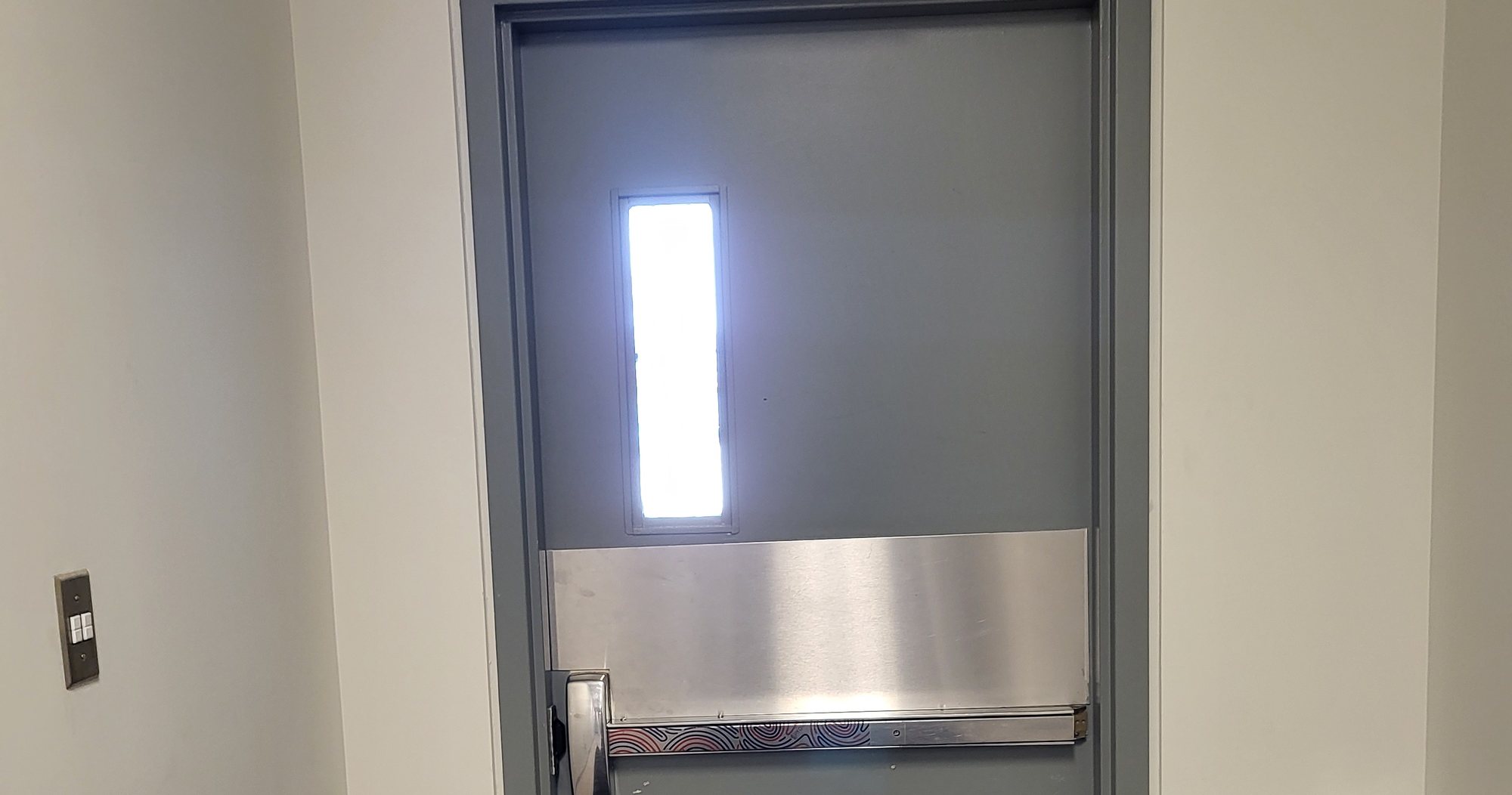
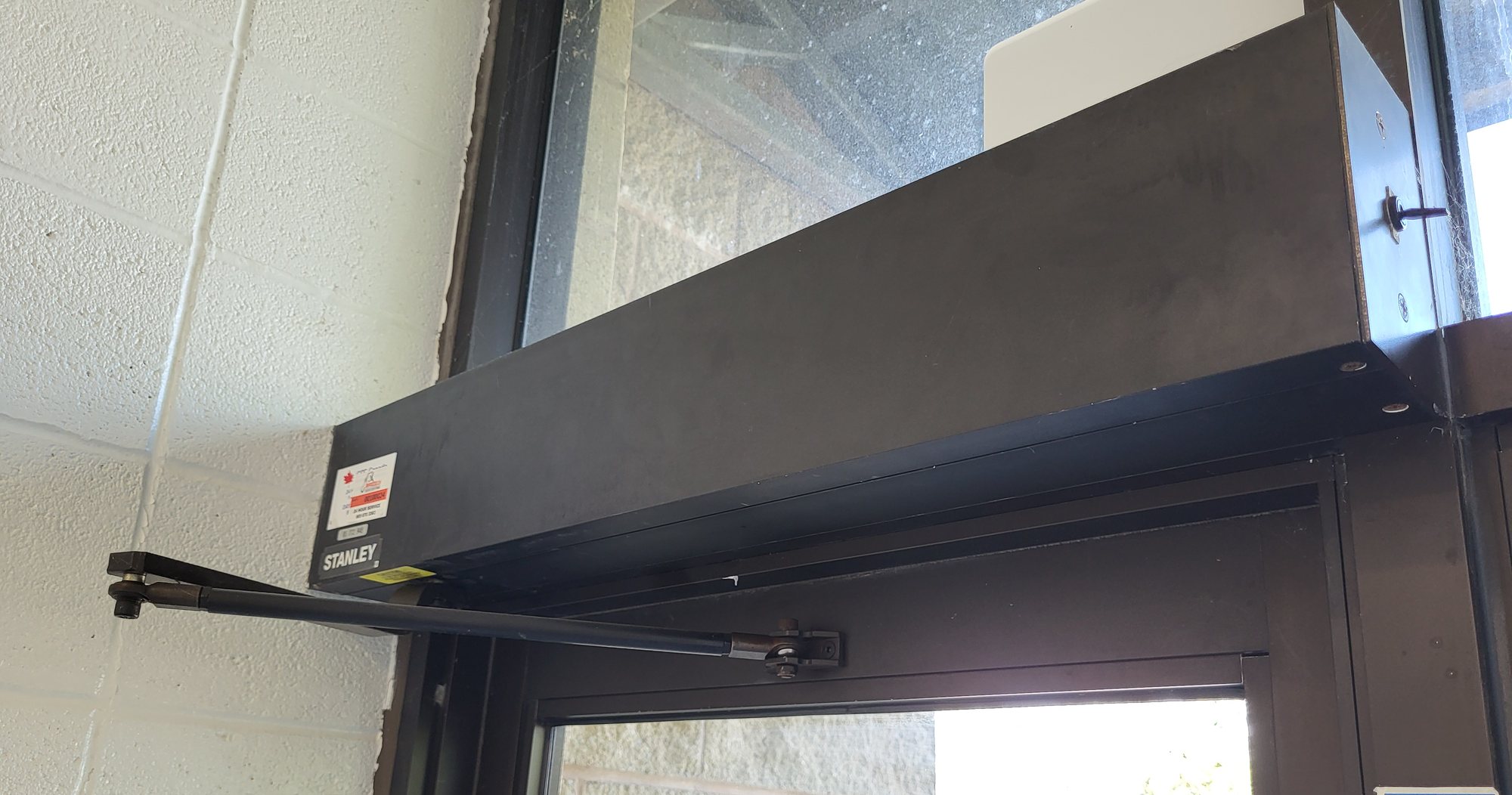
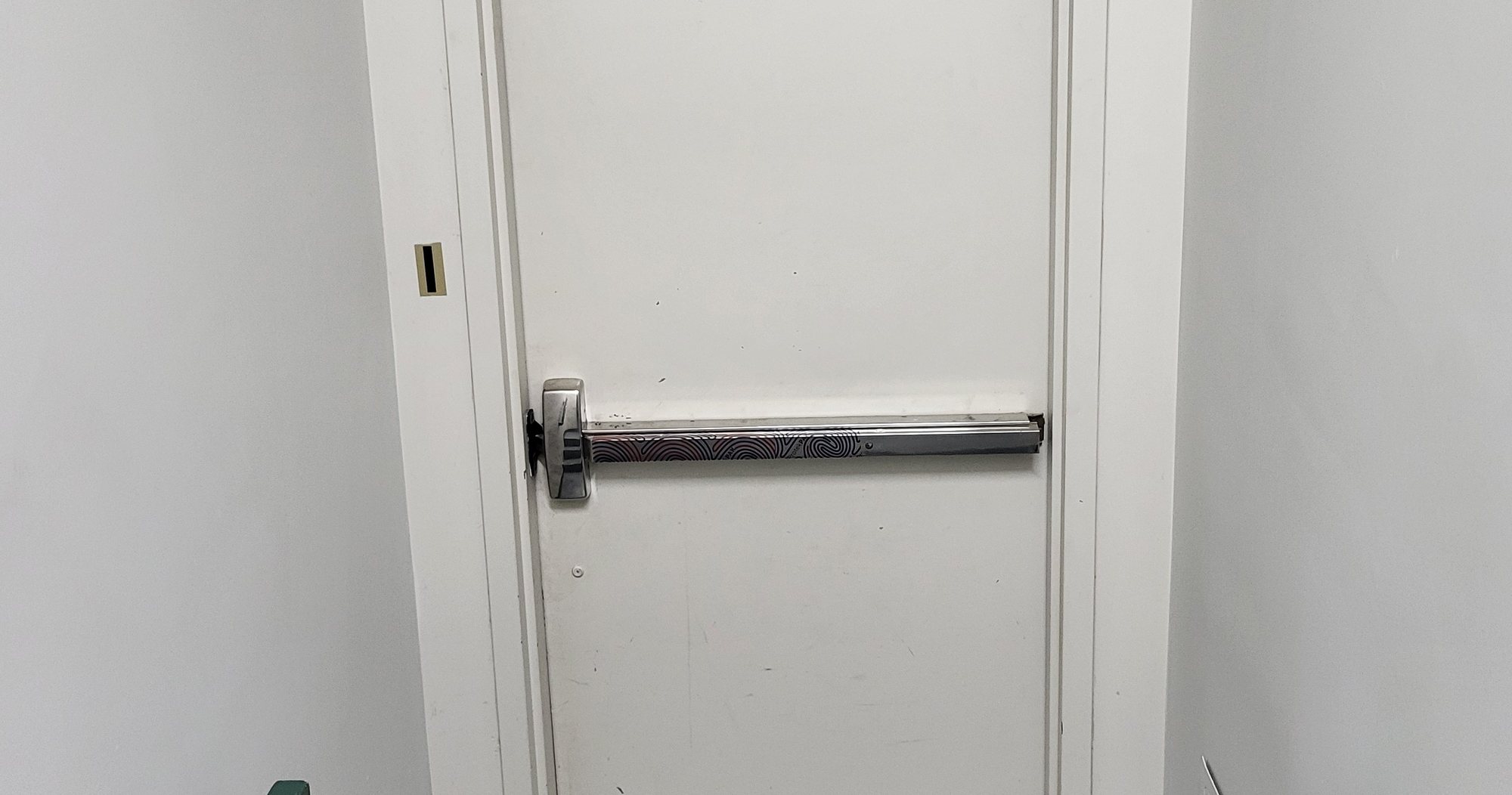
Every photograph on this site is our own, taken on our own jobs. Most assemblies fail on at least one of the thirteen, and most of those failures are small, cheap and invisible until somebody looks.
What has to be written down, and who has to hold it
Section 703.4 of the Fire Prevention Code requires records of inspection and testing to be maintained. NFPA 80 requires records for the assemblies it covers. Neither one prescribes a format.
The duty sits with the building owner. Where a managing agent runs the building, it is normal for them to hold the records on the owner’s behalf, but the obligation does not transfer by handing the task to a contractor — including to us.
Keep them available for as long as your Authority Having Jurisdiction or your insurer may ask to see them, which in practice means at least through the next inspection cycle. In Medicare-certified healthcare, keep them on the basis that a surveyor may ask during any survey window.
Records are the requirement. Photographs are not — they are our method. We include them because a photograph of a failed latch settles an argument that a tick in a box does not, and because next year it shows whether the fault came back.
What we put in a record
- Each of the thirteen checks, and the result of each one, per door
- A door number and tag, so findings follow that specific opening
- Photographs of anything that failed, and where on the assembly
- A grading of urgency, so a budget decision is possible
- The date, and who carried out the inspection
- Which edition of NFPA 80 the inspection was worked to
- An itemized estimate for the repairs, priced before any work starts
Delivered as an organized PDF. We keep a copy, so if yours goes missing we reissue it rather than re-inspecting.
Medicare-certified buildings are held to more
If your facility participates in Medicare or Medicaid, your fire door obligations are federal, explicit, and enforced by survey rather than by your local fire marshal.
CMS incorporates the 2012 edition of NFPA 101, the Life Safety Code, through 42 CFR § 482.41. That brings in annual inspection and testing of fire door assemblies, worked to the 2010 edition of NFPA 80. CMS required full compliance by 1 January 2018.
Two things follow that catch people out. The first is that non-rated doors are outside this requirement, so a corridor door with no label is not part of the annual fire door inspection — though it may have obligations of its own. The second is that CMS has said smoke door annual testing is not required in health care occupancies, with a narrow exception for new doors in horizontal exits.
Separately, CMS prohibits roller latches on corridor doors and on doors to rooms holding flammable or combustible materials; those openings need positive latching hardware.
What gets written up most often
- Corridor doors held open by wedges, kick-down stops or furniture
- Labels painted over during redecoration, or sanded off
- Doors that close but do not latch
- Vision lights cut into mineral core doors during a refurbishment
- No annual inspection record available when asked for
Whether a surveyor accepts what you hold is their decision, not ours. What we can do is make sure the work is right and the evidence is in order and dated.
NFPA 80, answered
Is NFPA 80 actually law in North Carolina?
How often do fire doors have to be inspected?
Which edition of NFPA 80 applies to us?
Does someone need a license or certification to inspect a fire door here?
Who is responsible for keeping the records?
What happens if a door fails one of the thirteen criteria?
Are non-rated corridor doors covered by NFPA 80?
We have rolling fire shutters. Are those different?
The 2024 code has been adopted. Do we need to do anything?
Do you do the repairs as well?
Book an NFPA 80 fire door inspection
A rough opening count and the building type is enough for us to come back with a number. We reply within one business day.
If you have a report from someone else and want a second opinion on it, send it over. We will tell you honestly whether we agree, including when we think it overstated the problem.
Direct line:
(704) 422-4968901 South Point Rd., Suite A #1042, Belmont, NC 28012
Monday to Friday, 8am–5pm. After-hours attendance by arrangement.
Request a quote
We reply within one business day. No obligation, and we quote before any work starts.