
Commercial door repair, installation, and compliance
Built for property and facility managers. From a single door that won’t close to full opening replacements — we service every door in your building, and inspect fire-rated assemblies to NFPA 80.
Request service
Tell us what the door is doing and we will come back to you within one business day. For anything urgent, call instead — it is faster.
No obligation. We quote before any work starts. Or call (704) 422-4968, Monday to Friday 8am–5pm.
The door problems buildings actually face
Property and facility managers don’t have time to guess. Find the symptom below to see the usual cause, what the fix involves, and whether code is in play.
The door won’t close properly
Usual cause: Hydraulic fluid leaking from the closer body, speed valves drifted out of adjustment, or an arm linkage bent by someone forcing the door.
Fix & code: Valve adjustment where the body is sound, replacement where it is not. Critical on a fire door, which has to close and latch on its own for the rated separation to mean anything.
It closes, but it won’t latch
Usual cause: Strike plate out of alignment, hinges sagging under the weight of the leaf, or a latch bolt worn round.
Fix & code: Shimming, strike realignment or latch replacement. This is the single most common fire door failure we find, and usually among the cheapest to put right.
It drags, sticks or binds
Usual cause: A continuous hinge pulling away from the frame, a warped leaf, or the building itself settling and taking the frame out of square.
Fix & code: Heavy-duty hinge replacement, frame squaring and shimming — done before frame torque bends the leaf permanently and turns a repair into a replacement.
The panic bar is jamming
Usual cause: Worn internal dogging mechanisms, a push bar bent by a cart or pallet, or a damaged latch head.
Fix & code: Mechanical rebuild or replacement. An exit device that does not release cleanly is a life safety problem before it is a code problem. In a Medicare-certified building it is squarely in scope: CMS enforces the 2012 Life Safety Code, which requires an egress door to open with no more than one releasing operation.
Damage from traffic
Usual cause: Pallet jacks, carts, dollies and dock traffic. Dents at kick height, frames struck at the jamb, bottom rails rusted through where floors are washed down.
Fix & code: Armour plates, kick plates and frame repair. On a rated assembly, repairs have to be made with tested materials — filling a hole and painting over it voids the label.
Locks, keys and access control
Usual cause: Worn cylinders, keys that no longer turn cleanly, mortise locks past their service life, or electric strikes and maglocks fitted without the right power transfer.
Fix & code: Cylinder and lock replacement, rekeying to your existing system, and electrified hardware wired so the door still releases on alarm and on power loss.
Drafts, noise and water
Usual cause: Perished weatherstripping, door sweeps worn away, thresholds loose or missing, and gaps that have grown as the frame moved.
Fix & code: Gasketing, sweeps and threshold replacement. On a rated assembly the seals are part of the listing, so the correct type matters — not whatever fits.
The door is past repair
Usual cause: A leaf that has been cut, patched and re-drilled until nothing holds, a frame rusted at the floor, or a label that can no longer be verified.
Fix & code: We will tell you when a replacement is the cheaper answer, and supply and fit the new opening — leaf, frame, hardware and the label documentation to go with it.
What worn hardware actually looks like
Photographs from our own commercial calls. Most faults come down to worn hardware or a frame that has moved.
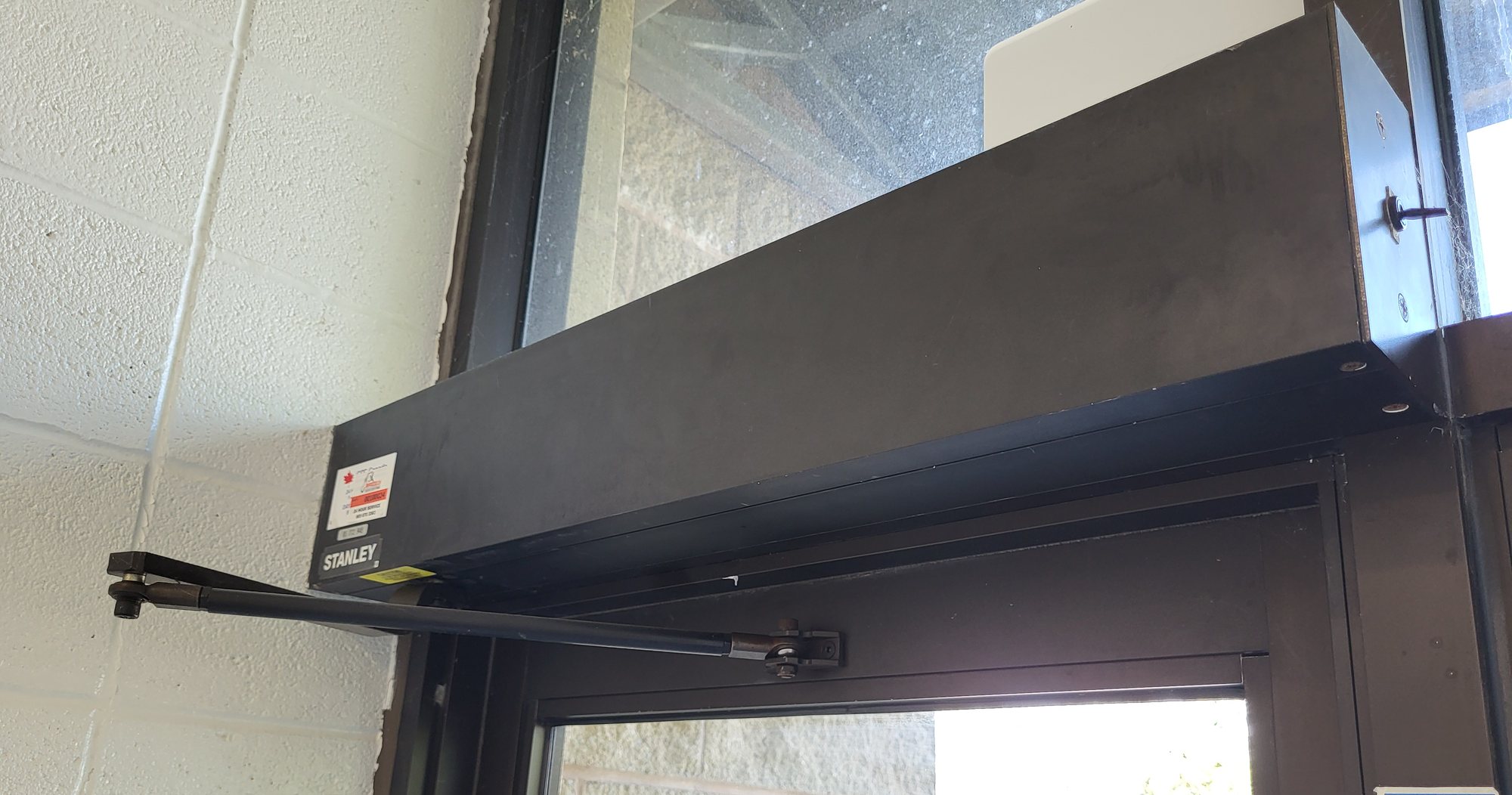
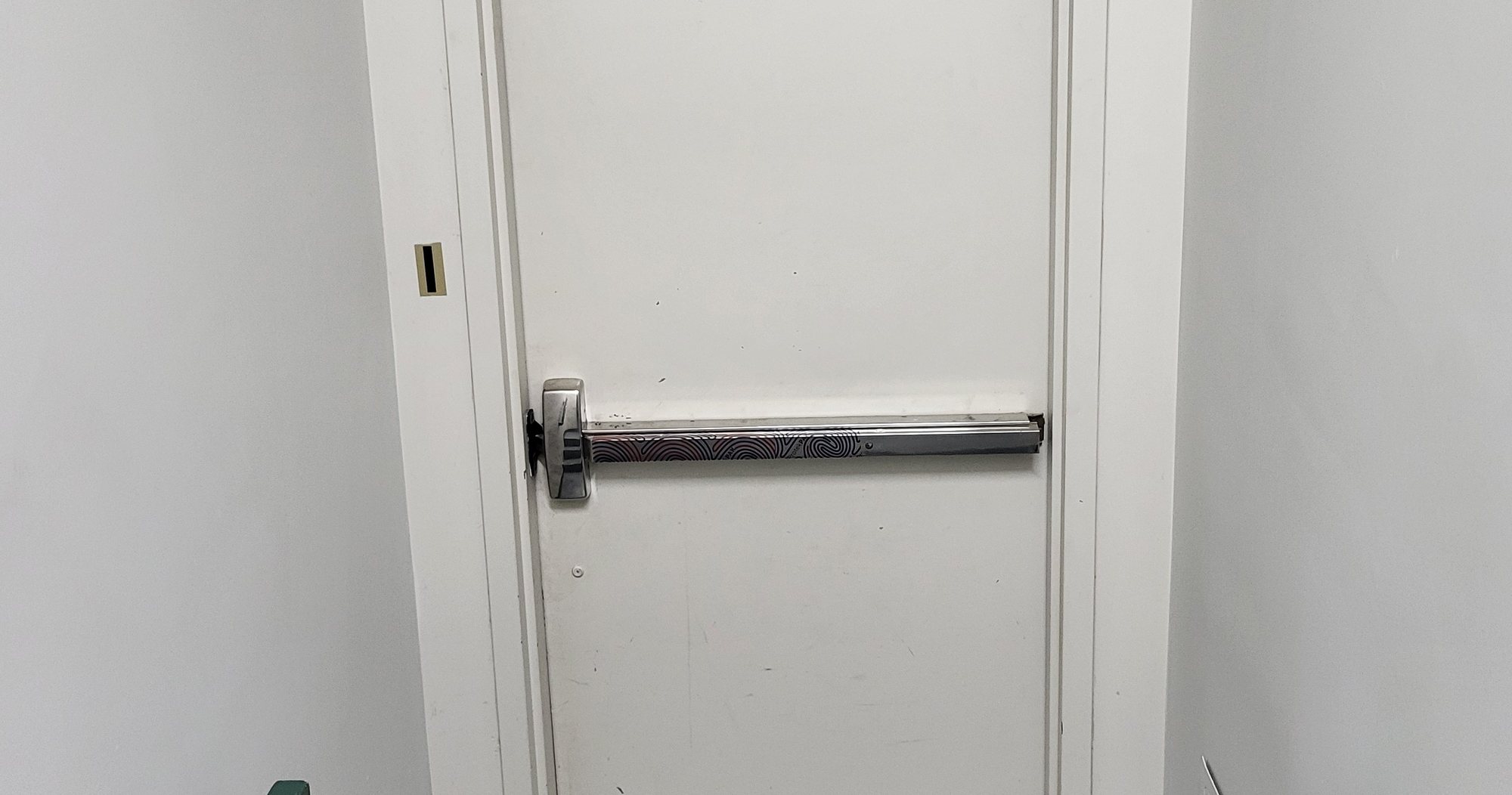
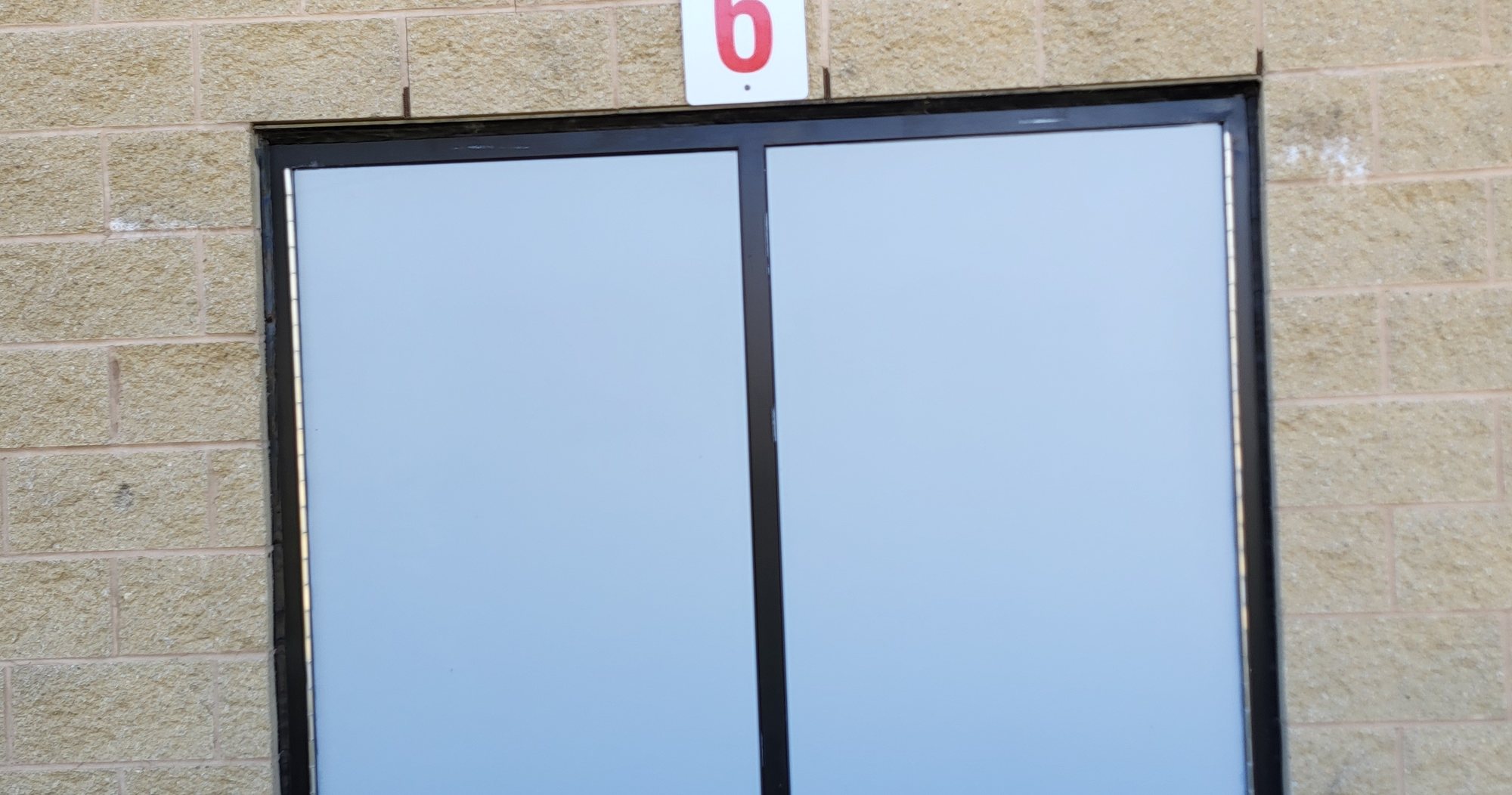
Doors, hardware, and compliance solutions
Serving commercial, industrial and institutional properties across the Charlotte metro. Book any service on its own, or combine them into a facility plan.
Commercial door repair
Closers, exit devices, hinges, latches, strikes, alignment, and hardware of every kind.
Explore repair services →Installation & replacement
Hollow metal, wood and glazed storefront doors, frames and full openings supplied and fitted.
Explore installation →Planned maintenance
Scheduled servicing across building portfolios, so doors get attention before they fail.
Explore maintenance →Fire door inspection
Per-door inspection and documentation to NFPA 80 criteria, photo-verified and recorded.
Explore inspections →NFPA 80 compliance
Annual inspection schedules built around the sections that actually apply to your building, with records retained and available to your fire marshal, surveyor or insurer.
Explore compliance →Commercial door assemblies we service
Fire door compliance is a specialism, not the limit of what we do. Every door in the building is in scope — rated or not.
Hollow metal doors
Steel leaves and frames in corridors, stairwells and back-of-house. The most common fire-rated assembly in a commercial building, and the one most often modified after installation.
Hollow metal doors →Storefront & glass doors
Aluminum storefront entrances, pivots, floor springs, concealed closers and automatic operators. Front-of-house, where every fault is visible to your tenants.
Storefront & glass doors →Wood corridor doors
Solid-core wood doors in offices, suites and patient corridors — including rated assemblies whose labels have been painted over or sanded off during redecoration.
Wood corridor doors →Rolling steel doors
Service counters, dock openings and rolling fire shutters, including drop testing and resetting the assembly after a release.
Rolling steel doors →Door closers
Surface, concealed and floor closers — adjusted, rebuilt or replaced. The single most common reason a door stops closing the way it was designed to.
Door closers →Exit devices & panic hardware
Rim, mortise, surface vertical rod and concealed vertical rod devices, electrified trim, and the hardware your egress route depends on.
Exit devices & panic hardware →One trade, done properly
Doors are not a sideline for us. They are the whole business, which is why we carry the parts, know the hardware and can tell you what a fault will actually cost before we start.
- You get the number before the work starts, not after
- Trucks stocked with the closers, strikes and hinges that fail most often, so most calls finish in one visit
- Every job photographed and recorded against the individual door
- Honest advice on what is urgent and what can wait until the next budget cycle
- Work scheduled around tenants, patients and shifts, including after hours
Built for the way facility managers work
If you look after more than one building, the problem is rarely the repair. It is getting the same scope, the same report format and the same paperwork out of every site.
We standardise all three. One report format across your portfolio, findings graded the same way everywhere, and a record you can hand to a surveyor without reformatting it first.
Repair or replace — how we decide
Most door companies quote whichever is worth more to them. Here is the test we actually apply, so you can check our recommendation against it.
We repair when
- The leaf and frame are structurally sound and still square
- The fault is in the hardware — closer, strike, hinge, latch, seal
- A rated label is present, legible and verifiable
- Any previous modification can be brought back within the listing
- The repair will hold for years, not months
We replace when
- The leaf has been cut, patched or re-drilled until no fixing holds
- The frame is rusted through at the floor or twisted out of square
- A rated assembly has been modified in a way that voids the label and cannot be reversed
- The label is gone and the rating cannot be established
- The repairs are adding up to more than a new opening would cost
Either way, you get the reasoning in writing with photographs attached, so the decision is documented and not just asserted.
What North Carolina actually requires, and for which doors
Most door companies will fix a fire door without telling you it no longer meets code. A good many will also tell you the code says something it does not. Here is the obligation as it actually reads, with the section numbers so you can check us.
Three different requirements, not one
North Carolina enforces the 2018 NC Fire Prevention Code, which is the 2015 International Fire Code with North Carolina amendments. Under it, fire door obligations do not all work the same way.
Sliding and rolling fire doors — explicit in the code. Section 703.4 requires horizontal and vertical sliding and rolling fire doors to be inspected and tested annually to confirm proper operation and full closure, with records maintained. If you have rolling fire shutters or a counter shutter, drop testing is required by the code text itself. No interpretation needed.
Swinging fire doors — through NFPA 80. Section 703.2 requires opening protectives to be maintained in operative condition in accordance with NFPA 80, which is where the annual inspection of a swinging fire door assembly comes from. It is a real obligation, but it reaches you by reference rather than by a sentence in the Fire Code, and we would rather say that plainly than imply otherwise.
Medicare-certified healthcare — federal, and explicit. CMS enforces the 2012 Life Safety Code under 42 CFR § 482.41, which brings in annual fire door inspection and testing. CMS required full compliance by 1 January 2018, and fire door deficiencies remain a recurring survey citation. Non-rated doors are outside it.
The edition matters and almost nobody gets it right. North Carolina’s 2018 codes reference NFPA 80, 2013 edition — the NC Office of State Fire Marshal cites it that way in its own published formal interpretation. CMS-certified facilities are held to the 2010 edition instead, through the 2012 Life Safety Code. Section numbering shifts between editions, so we work to the edition your Authority Having Jurisdiction has adopted and we say which one on the report.
A 2024 NC code based on the 2021 IFC has been adopted but its effective date is deferred under Session Law 2025-2. The 2018 code remains in force. When that changes, the section numbers move from 703 to 705 — which is why anyone quoting 705 at you today is reading the wrong book.
It is also widely unmet. In our experience most commercial buildings in the Charlotte area have never had a formal fire door inspection, and many owners are unaware any of this applies to them.
New doors have a requirement of their own
Newly installed fire-rated doors in North Carolina have to be tested on site by someone trained by the manufacturer, and that documentation has to be produced before a certificate of completion is issued — the NC Office of State Fire Marshal said so in a formal interpretation dated 28 October 2020, read together with G.S. 160D-1116.
It is a competence requirement rather than a licence, and it is routinely missed on fit-outs. If you are taking handover of a building, it is worth asking who tested the rated openings and whether the paperwork exists.
The thirteen checks, at a glance
NFPA 80 lists thirteen things an inspector has to verify on a swinging fire door with builders hardware. We check every one, on every door, and record the result.
- Label present and legibleWithout it the rating cannot be proved
- No unapproved holes or breaksOld lock, closer and card-reader prep
- Glazing and beads intactRated glass, stops secure, nothing cracked
- Door, frame, hinges, threshold soundAligned, secured and undamaged
- Nothing missing or brokenHinge screws, latch parts, closer arms
- Clearances within limits3/16 in. at the edges, 3/4 in. undercut
- The self-closer closes it fullyFrom fully open, with no help
- Coordinator sequences pairsInactive leaf has to close first
- Latch engages and holdsIt must throw into the keeper
- Nothing blocking closureSurface bolts, wedges, chains, hold-opens
- No label-voiding modificationsCuts, trims or drilling beyond the listing
- Gasketing and edge seals intactCorrect type, continuous, undamaged
- Signage within limits5% of the face, adhesive not screws
What each check means on an actual door, and what usually fails it
- The label is there and you can read it — No label, or a label painted over, sanded off or buried under a sign, and the rating cannot be established. This is the most common single failure we find, and the one with no cheap fix.
- No unapproved holes or breaks — Old lock prep, removed closers and card-reader cutouts leave holes. Some are permitted by the listing; most are not, and filling one with body filler does not make it compliant.
- Glazing and beads are intact and secure — Vision lights have to be the rated glazing, held by the right beads, with nothing cracked or loose.
- Leaf, frame, hinges, hardware and threshold are sound — Everything secured, aligned, working and undamaged — including the noncombustible threshold, which is often the piece that has been removed during a floor replacement.
- Nothing is missing or broken — Hinge screws, latch parts, closer arms, gasketing, spacers. A door missing one hinge screw per leaf is not a compliant door.
- Clearances are within limits — Generally no more than 3/16 in. at the head, jambs and meeting stiles of a hollow metal assembly, 1/8 in. for wood doors rated above 20 minutes, and no more than 3/4 in. underneath. Gaps grow as buildings settle, so this fails quietly.
- The self-closing device actually closes the door — Released from fully open, the door has to close completely on its own. Not nearly, not with a nudge.
- On pairs, the coordinator sequences the leaves — The inactive leaf has to close before the active one, or the astragal holds the pair open.
- The latch engages and holds — Closing is not enough. The latch has to throw into the keeper and secure the door, which is where misaligned strikes and worn bolts show up.
- No added hardware stops it closing or latching — Surface bolts, hold-open hooks, wedges, chains and extra deadbolts fitted after the fact. If it defeats closing or latching, it has to come off.
- No field modifications that void the label — Cutting in a vision light, trimming the leaf or drilling for hardware beyond what the listing allows voids the rating. Where a modification is found, it gets documented and raised with the AHJ rather than quietly left.
- Gasketing and edge seals are present and intact — Where the listing requires them, smoke and intumescent seals have to be the correct type, continuous and undamaged — not whatever was in the van.
- Signage is within the limits — Signs on the door face are capped at 5% of the face area and must be attached with adhesive, not screws or rivets. A screwed-on room number is a hole, and a hole is a failure.
Every one of these is recorded per door with photographs, graded for urgency, and dated. That record is what you hand over when a fire marshal, surveyor or insurer asks what has been done.
A record, not a clipboard
Every job — repair or inspection — comes back as a structured record rather than a one-line invoice description.
- Doors numbered, tagged and tracked individually
- Photographs of the problem and the fix
- Findings graded, so you know what is urgent and what can wait
- Dated records retained and reproducible for the AHJ or a surveyor
- History carried forward, so you can see which doors keep failing
Why it matters at budget time
A record tells you which buildings are consuming your maintenance spend and which doors are due for replacement rather than another repair.
It also means that when a fire marshal or a surveyor asks what you have done, the answer is a file rather than a scramble.
What we carry and what we service
Commercial hardware is not interchangeable, and matching a replacement to what is already on the door is most of the job. These are the lines we see and work on across the Carolinas.
Closers
- LCN
- Norton
- Dorma
- Falcon
- Yale
- Stanley
- Sargent
Exit devices
- Von Duprin
- Precision
- Detex
- Jackson
- Adams Rite
- Falcon
Locks & cylinders
- Schlage
- Sargent
- Corbin Russwin
- Best
- Yale
- Arrow
Hinges & frames
- Hager
- Ives
- McKinney
- Select
- Steelcraft
- Ceco
- Curries
We are not a dealer for any of these manufacturers. We service, repair and replace their hardware as an independent contractor, which means the recommendation is based on the door rather than on a supply agreement.
Commercial, industrial and institutional buildings
Single sites and multi-building portfolios.
Healthcare & senior living
Documentation that supports CMS survey and Joint Commission expectations, with work windows that respect patient movement and infection control.
Property management
Multi-building portfolios, consolidated reporting, and work scheduled around tenants and leasing activity.
Industrial & distribution
High-traffic damage, dock areas, rolling steel doors and fire shutters, with attendance outside production hours.
Retail & multi-site
A standard scope across locations, one report format, and after-hours attendance so the store trades as normal.
Three steps, no surprises
Tell us the problem
Call us or use the request form. For a single door we can often quote from photographs once we are in touch; for a portfolio we walk the site first and count the openings.
We quote, then we fix
You get the number before work starts. Most repairs are completed in a single visit, because the parts that fail most often are already on the truck.
You get the record
Photographs, what was found, what was done — filed against that individual door, so it is there the next time anyone asks.
Across the Charlotte metro and the Carolinas Piedmont
Mecklenburg, Cabarrus, Gaston, Union and Iredell counties in North Carolina, and York County in South Carolina. One region served properly rather than a map we cannot attend.
Outside these areas? Ask anyway. Rated Door Services is the door division of Kibog, which works across a wider footprint, and we will tell you honestly whether we can attend.
Before you call
Do you handle one-off repairs, or only contracts?
How quickly can you attend?
What does it cost?
Do you replace doors, or only repair them?
Do you only work on fire-rated doors?
Can you tell if our fire doors are compliant?
What do we get at the end of an inspection?
Are you insured?
Do you work outside business hours?
We have been told our doors failed an inspection. Can you fix them?
Who actually turns up?
A door company with a facilities background
Rated Door Services is the door division of Kibog, a commercial facility services company. Kibog Inc. is our US entity, and this is the same team working under one trade rather than a separate business.
That background shapes the work. The documentation platform behind our inspection and repair reports was built for managing work across multiple sites, not bolted on afterwards. And we combine an engineering background with hands-on contracting experience, which means the mechanical detail of an opening and the paperwork behind it get the same attention.
It also means we can look after more than the doors. Where a building needs general repairs, multi-trade maintenance or preventative work beyond our own trade, Kibog covers it — one vendor for everything your building and facility needs.
Fire door and commercial door guidance
Plain-language notes on NFPA 80, inspection criteria and the faults we see most often.
-
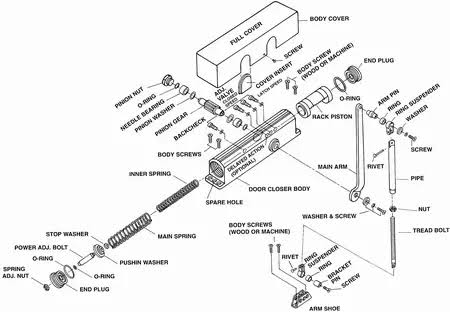
Why Commercial Door Closers Leak Oil (And Why It’s a Safety Violation)
Hydraulic fluid pooling under a commercial door closer isn’t just a mess—it’s a critical hardware failure that compromises fire code safety. Learn…
Tell us about the door
A sentence about the door is usually enough for us to tell you what is involved. Once we have replied, send photographs to the same address and we can often quote the job without attending at all.
Managing a portfolio? We will walk the buildings, count the openings and quote the whole scope.
Monday to Friday, 8am–5pm. After-hours attendance by arrangement.
Rated Door Services is a division of Kibog Inc., serving Charlotte, the Carolinas Piedmont and York County, SC.
Request service
Tell us the building, the door and what it is doing. We reply within one business day with either a quote or the one question we need answered first.
No obligation. We quote before any work starts, and your details are used only to respond to this enquiry.