The Three Fire Door Requirements in North Carolina
Most commercial buildings in North Carolina carry an annual fire door duty. Very few owners can tell you which of three separate routes puts it there — and the route decides what you actually have to do, which doors it covers, and which edition of a standard you are being measured against.
Search for this and you will find the same sentence on every contractor’s website in the state: “NFPA 80 requires annual fire door inspection.” It is true, incomplete, and interchangeable between every company that says it. It also skips the part that matters, which is how that requirement reaches your particular building.
There are three routes. They land differently.
Route one: sliding and rolling fire doors, written in plain code text
North Carolina enforces the 2018 NC Fire Prevention Code, which is the 2015 International Fire Code with North Carolina amendments. Section 703.4 of that code requires annual inspection and testing of horizontal and vertical sliding and rolling fire doors, with records maintained.
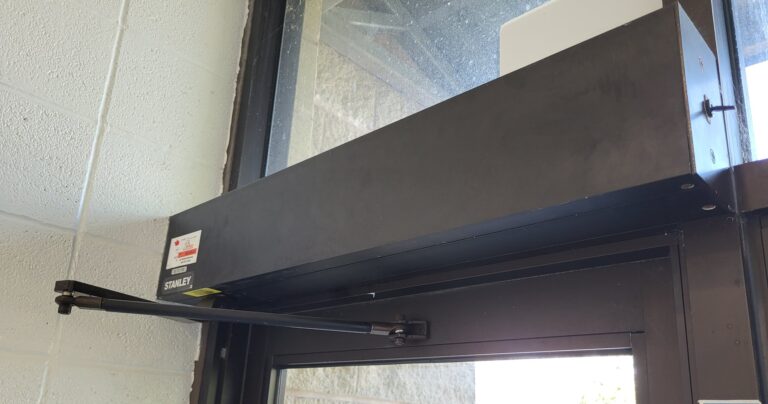
That is unusually direct. There is no reference to follow and no standard to buy. If your building has a rolling steel fire shutter over a service counter, a coiling fire door across a warehouse opening, or a horizontal sliding fire door in a back-of-house corridor, the annual test and the record are stated requirements.
This is the route most often satisfied by accident and most often missed entirely. Buildings with a prominent coiling shutter tend to get it tested. Buildings whose sliding fire door sits in a service route nobody walks down can hold one for twenty years without anybody realising it carries a duty at all.
Route two: swinging fire doors, by reference
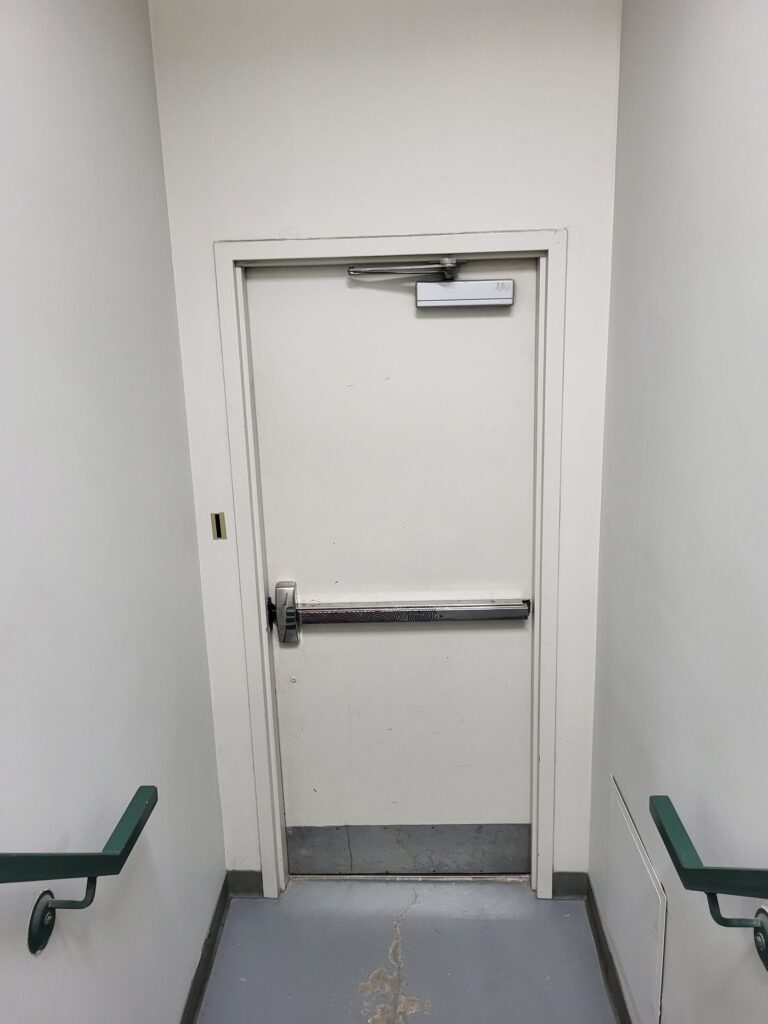
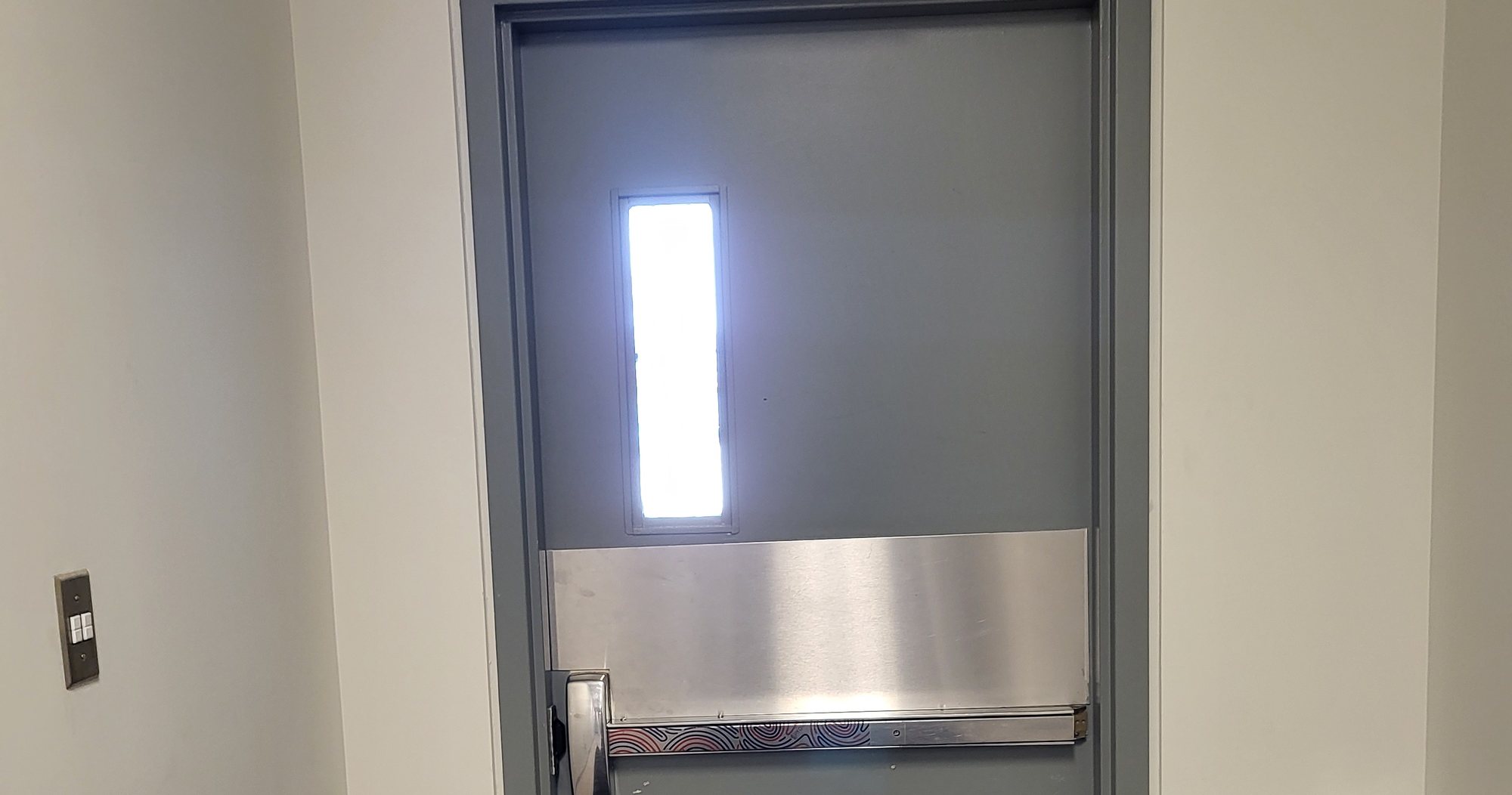
For the ordinary swinging fire doors that make up almost every rated opening in a commercial building — stairwells, corridors, risers, plant rooms — the duty arrives differently. Section 703.2 requires opening protectives to be maintained in an operative condition in accordance with NFPA 80.
So the Fire Code does not spell out the inspection. It points at a standard, and the standard does. That has two consequences worth understanding.
The edition matters. North Carolina’s 2018 codes reference the 2013 edition of NFPA 80, as the NC Office of State Fire Marshal itself cites it. Anyone quoting a different edition at you is either working from another state’s adoption or from a sales sheet.
And NFPA 80 is a standard, not a code. It cannot issue a violation; an Authority Having Jurisdiction can. You will see “NFPA 80 violation” written on a great deal of marketing material, including, until recently, our own. It is a category error, and it is a reasonable signal of how carefully the rest of the page was written.
Route three: Medicare-certified healthcare, which is federal
If your building is a Medicare-certified healthcare facility, a third requirement applies on top, and it comes from Washington rather than Raleigh.
CMS enforces fire door inspection through 42 CFR § 482.41, which adopts the 2012 Life Safety Code, which in turn references NFPA 80, 2010 edition. The compliance deadline was 1 January 2018.
Notice that this is a different edition of the same standard from the one the state codes reference. That is not an error in this article. A hospital in Charlotte can be measured against the 2010 edition by a CMS surveyor and the 2013 edition by a state inspector, in the same building, in the same year.
This is also the one route that is explicit rather than inferred, which makes it the strictest of the three in practice. It applies identically in every state.
Two things you will be told that are wrong in North Carolina
“NFPA 101, the Life Safety Code, requires it.” Not in North Carolina it does not. North Carolina is an I-Code state — it adopts the International Fire Code, not NFPA 101. The Life Safety Code reaches your building only through CMS, and only if you are Medicare-certified. If someone cites NFPA 101 at a Charlotte office building, they are citing the wrong book.
“Section 705 requires it.” Also not today. Section 705 is where these provisions live in the 2021 and 2024 editions of the International Fire Code. North Carolina adopted a 2024 code based on the 2021 IFC, and then deferred it under Session Law 2025-2. Until that deferral lifts, North Carolina is still on the 2015 IFC and the numbering is 703. Quoting 705 in this state is quoting a code that is not yet in force.
That one is genuinely confusing, because 705 is the correct section just across the state line. South Carolina moved to the 2021 IFC on 1 January 2023. The same requirement, a different number, forty minutes down I-77.
What to do with this
Work out which routes apply to your building before you buy anything. In practice that means three questions.
- Do you have any sliding or rolling fire doors? If yes, route one applies and the requirement is explicit. Rolling steel doors and fire shutters covers what that test involves.
- How many swinging fire doors do you have, and where? Route two covers all of them, and the number is almost always higher than the building’s drawings suggest. The most common way they fail is closing without latching.
- Are you Medicare-certified? If yes, route three applies on top, with its own edition and its own surveyor.
None of this requires you to become an expert. It does mean that when a contractor tells you what the code says, you can ask which route they are talking about — and a contractor who cannot answer that is quoting a sentence they found on someone else’s website.
What the code requires, in full Fire door inspection
A note on sources. NFPA 80 and NFPA 101 are paywalled standards and we have not read them. Every NFPA reference above comes from a government document citing the standard, which is why you will find no quoted passages from either on this site. The code sections, the adopted editions and the CMS chain are all verifiable from public records, and we would rather tell you where a claim comes from than ask you to take it on trust.