
Operable partitions, sliding and pocket doors
Folding partitions that divide a room in two, pocket doors that disappear into a wall, and the sliding fire doors the Fire Code names in plain text. Repaired, realigned and resealed across the Charlotte metro.
The openings that move sideways, and the ones nobody owns
A folding partition is usually the only moving wall in a building. That is exactly why it gets neglected — it is not quite a door, so it falls outside whoever looks after the doors, and it is not quite a wall, so it falls outside whoever looks after the building.
Then it stops working on the morning a room has to be split in two for a meeting that was booked six weeks ago.
Sliding and folding openings fail differently from swinging doors. A swinging door hangs from hinges on a frame, and almost everything that goes wrong is at that edge. A sliding opening hangs from a track in the structure above, runs on carriers, and seals along four edges instead of latching at one point. So the fault is almost never where the symptom is.
We repair, realign and replace these across corporate, healthcare, hospitality, education and conference properties.
What we service
- Operable and folding partitions: the paneled walls that turn one large room into two smaller ones — track, carriers, panel hinges, seals and alignment.
- Pocket doors: sliding leaves that recede into a wall cavity, common in healthcare and offices where a swing would block a corridor.
- Surface sliding doors: leaves running on exposed track across a wall face, including barn-style and industrial applications.
- Horizontal sliding fire doors: rated sliding assemblies, which carry an annual inspection and testing duty written into the Fire Code — see the next section.
- Acoustic seals: top, bottom and inter-panel seals, which are what a partition was actually bought for.
We do not cover automatic sliding door operators. Those fall under a separate safety standard with its own commissioning and inspection regime, and we would rather tell you that than take the work.
If your sliding door is a fire door, the Fire Code names it by name
Most fire door duties in North Carolina arrive indirectly, through NFPA 80. Sliding fire doors are one of the two exceptions where the code says it outright.
Section 703.4, in plain words
The NC Fire Prevention Code requires annual inspection and testing of horizontal and vertical sliding and rolling fire doors, with records maintained.
That is the same section that puts rolling steel fire doors on an annual drop test — and it names horizontal sliding assemblies in the same breath. So a sliding fire door carries the same explicit duty as a rolling shutter: tested every year, with a record kept.
This gets missed more than almost anything else in the trade. Horizontal sliding fire doors are uncommon, they are often old, and they frequently sit in parts of a building nobody walks through — back-of-house corridors, older industrial bays, service routes between departments. A building can hold one for twenty years without anybody realising it is an assembly with an annual requirement attached.
How to tell. The label. A rated sliding assembly carries one, usually on the edge or the top rail of the leaf, and it names the rating. If there is a label, the annual duty applies. If you cannot find one, that is worth establishing rather than assuming either way.
North Carolina enforces the 2018 NC Fire Prevention Code, which is the 2015 IFC with NC amendments. NFPA 80 is a standard rather than a code, and it binds because the Fire Code adopts it by reference — NC’s 2018 codes reference the 2013 edition. In Medicare-certified healthcare, CMS adds a separate federal path through the 2012 Life Safety Code.
Most operable partitions and pocket doors are not rated, and nothing above applies to them. The point is that you cannot tell from across the room — and the consequence of being wrong falls on the building owner rather than on whoever last worked on it.
A partition that closes but does not seal has already failed
This is the thing about operable partitions that gets misunderstood, and it is the same shape as the fire door argument elsewhere on this site: the partition can look and feel completely fine while no longer doing the one thing it was installed for.
Nobody buys a folding wall to divide a room visually. They buy it so two things can happen in one room at once — a training session on one side, a meeting on the other. That depends entirely on the acoustic seals: the sweep at the floor, the seal at the ceiling track, and the seals between every pair of panels.
Those seals are rubber and brush, they are compressed and released hundreds of times a year, and they are the first component to wear. When they go, the partition still rolls out, still looks right, still latches at the jamb — and you can hear the other room clearly. At that point the room has stopped being two rooms, which is the entire reason the wall is there.
The fault is usually above the ceiling
When a partition becomes hard to pull across, binds halfway, or drops at one end, people look at the panels. The panels are rarely the problem.
- The track. A partition hangs from a track fixed to the structure above the ceiling. If that structure has deflected — and buildings do settle — the track is no longer straight and the partition fights it along its whole run.
- The carriers. Each panel hangs from wheeled carriers running in the track. They wear, they seize, they collect construction dust from whatever work was done in the ceiling since.
- The floor. The bottom seals were set to the floor as it was on installation day. A floor that has moved, or new flooring laid over the old, changes the gap the seal has to close.
- The stack. Panels park in a pocket or a closet at one end. If the stack is tight, mis-ordered or obstructed, panels get forced and the edges take the damage.
The other factor is who operates it. A partition is usually moved by whoever has the room next — and forcing a binding panel is how a track problem becomes a panel problem.
We service the track, carriers, panel hinges, seals and alignment, and we will tell you plainly when a partition has reached the point where repair stops being the better value.
The hardware is inside the wall, which is why it gets ignored
A pocket door exists for a good reason: it takes up no floor space and it does not swing into a corridor. That makes it the right answer in healthcare, in imaging suites, in small offices and anywhere a swinging leaf would block a route.
It also means every moving part is behind plasterboard. So where a sticking swing door gets looked at, a sticking pocket door gets shoved a bit harder for eighteen months until it stops moving at all.
- It drags or will not run. Usually the rollers or the track inside the pocket. Reachable through the head or by dropping the leaf, without opening the wall in most cases.
- It has jumped the track. Often the result of being forced while already binding, and sometimes a guide at the floor that has broken or gone missing.
- It is heavy to move. Worth taking seriously rather than living with, because operating force is an accessibility question as much as a convenience one — particularly on a patient room or an accessible washroom.
- It will not stay shut, or rattles. The jamb hardware, the pull or the soft-close, rather than the track.
Rated pocket doors exist and are a specialist assembly. If the opening is rated, the leaf, the pocket, the hardware and the seals all form part of what was listed — so a repair done without regard to that can quietly take the rating with it.
What goes wrong on a sliding opening
Four faults account for most of the calls we take on partitions and pocket doors.
It closes but you can hear through it
Seals goneThe partition rolls out and latches, and the room is no longer two rooms. The acoustic seals at the floor, the ceiling and between panels have worn or compressed flat. This is the fault most often reported as “the partition is fine, the room is just noisy” — and it is the one that has actually defeated the purpose of the wall.
It binds or is hard to pull across
Track or carriersHeavy from the start, or it sticks at the same point every time. Worn or seized carriers, debris in the track, or a track that is no longer straight because the structure above it has deflected. Forcing it through the tight spot is what turns this into panel damage.
A pocket door drags or has jumped
Rollers and guidesScraping on the floor, running off its line, or off the track entirely. Rollers, the track inside the pocket, or a floor guide that has broken. Usually reachable without opening up the wall, which is the question everybody asks first.
Panel edges damaged at the stack
Stacking and handlingChewed edges, torn finish, bent trim where panels park. A tight, obstructed or mis-ordered stack, panels being forced by whoever needed the room, or a pocket that has had storage put in it. Repairable, and worth fixing the cause rather than the panel.
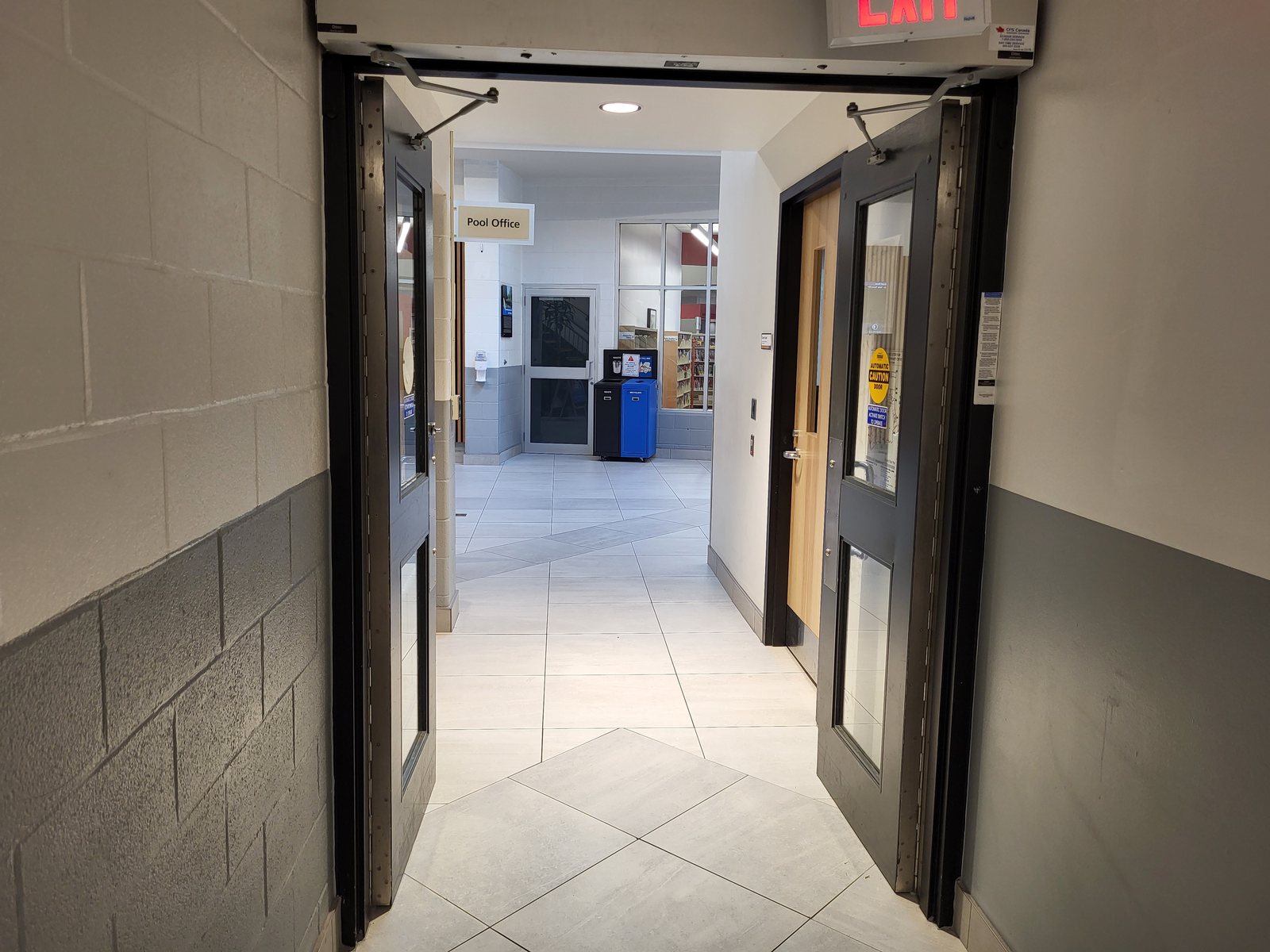
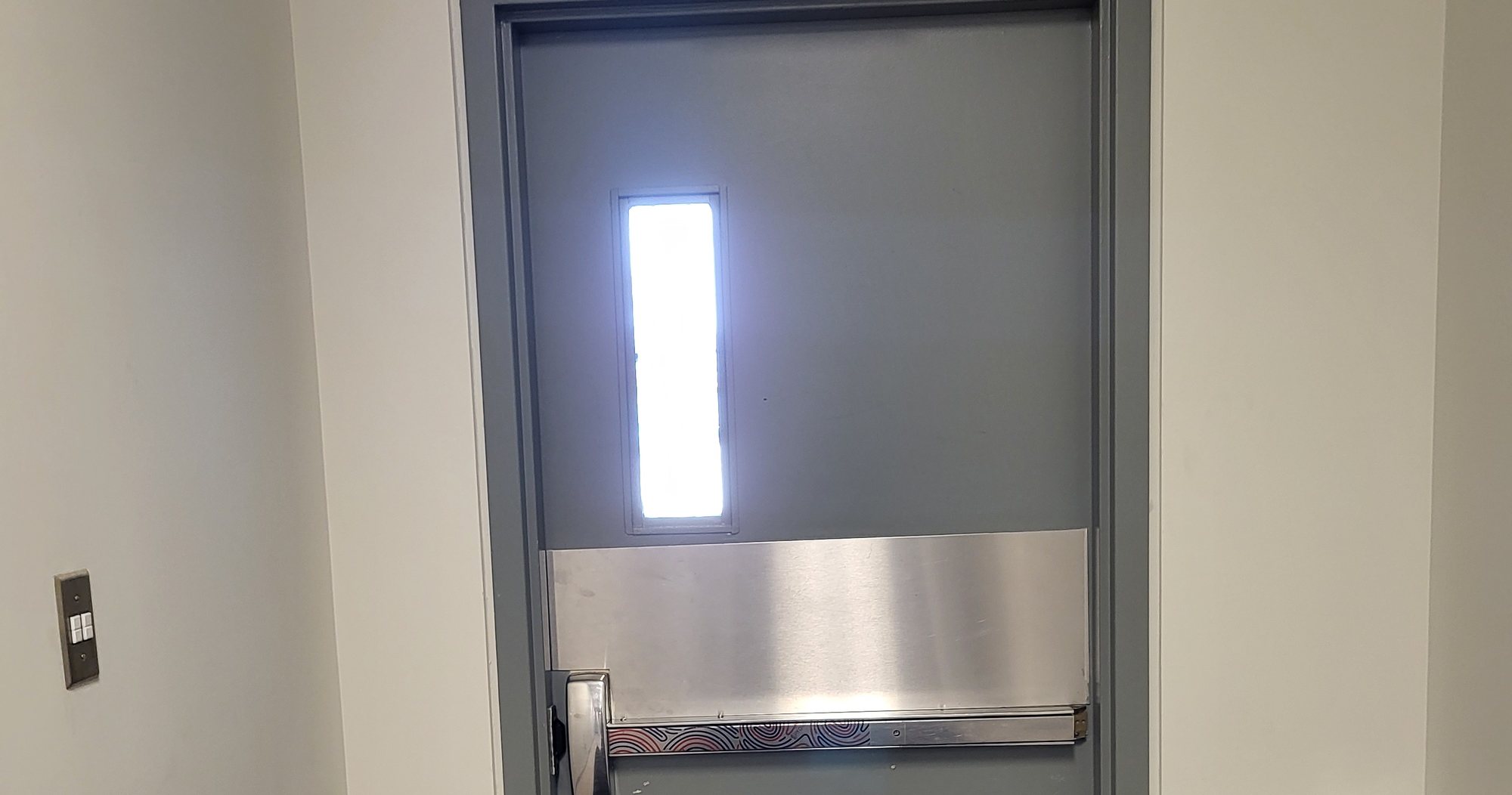
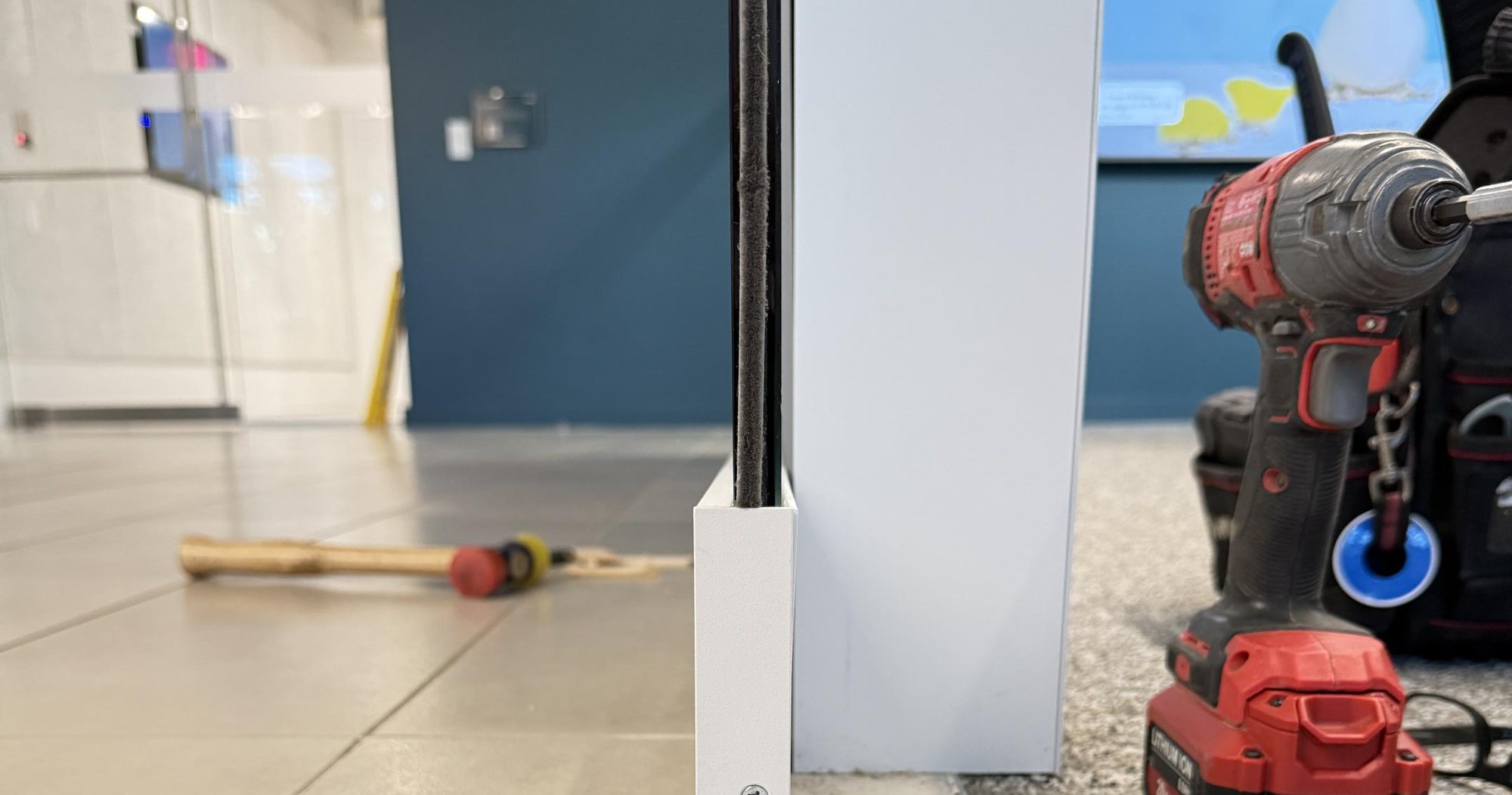
Where these openings live
Every photograph on this site is our own, taken on our own jobs.
Partitions and sliding doors, answered
Our folding partition closes properly but we can hear the next room. Is that fixable?
The partition is hard to pull across. Are the panels too heavy?
Who is actually supposed to maintain a folding partition?
Does a sliding fire door need an annual inspection?
How do I know whether our sliding door is fire rated?
Can you work on a pocket door without opening up the wall?
Can a folding partition be fire rated?
Is it worth repairing an old partition or should we replace it?
Tell us what the opening is doing
Binding, dragging, not sealing, off its track, or a sliding assembly you need checked against the annual requirement. We reply within one business day.
Once we have replied, send photographs to that thread. For a partition, a shot down the full run with it closed plus one of the stack is more useful than a close-up — the fault is usually not where the symptom is.
A room you need split for a date already in the diary? Say so and say when. That changes how we schedule it.
Direct line:
(704) 422-4968901 South Point Rd., Suite A #1042, Belmont, NC 28012
Monday to Friday, 8am–5pm. After-hours attendance by arrangement.
Coiling and rolling assemblies instead? See rolling steel doors and fire shutters.
Request a quote
We reply within one business day. No obligation, and we quote before any work starts.