
Why Commercial Door Closers Leak Oil (And Why It’s a Safety Violation)
If you manage an office building, healthcare suite, retail center, or industrial facility in Charlotte, you’ve likely encountered a familiar maintenance issue: dark, oily fluid dripping from an overhead door closer onto the door leaf, frame, or floor below. Many facility teams treat a leaking closer as a minor housekeeping annoyance—putting down a rag, wiping the frame, or ignoring it until the next budget cycle.
However, hydraulic fluid leakage is not a cosmetic defect. It is the definitive sign of total internal seal failure. Once a commercial door closer loses its hydraulic fluid, it loses its ability to regulate closing speed, latching force, and backcheck resistance. What begins as a small drop of oil quickly transforms a heavy commercial opening into a physical injury hazard, an unsecure entry, and an immediate fire code violation under NFPA 80.
How a Heavy-Duty Commercial Hydraulic Door Closer Operates
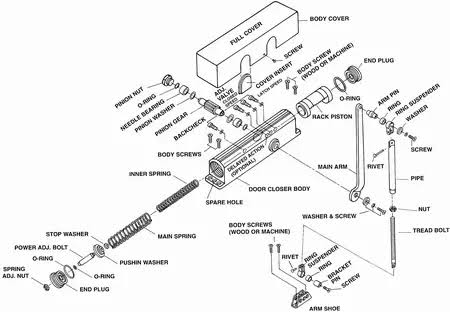
To understand why leaking fluid is so destructive, it helps to examine how commercial surface-mounted door closers—such as LCN 4040XP, Norton 1600 series, or Sargent 1431 units—are engineered inside. A heavy-duty closer is a self-contained, high-pressure hydraulic machine designed to control the heavy momentum of steel, wood, or glass door leaves.
Inside the aluminum or cast-iron closer body sits a heavy-gauge steel spring surrounded by high-grade hydraulic oil. When a tenant or visitor pushes the door open, the pinion shaft rotates, compressing the internal spring and transferring fluid through internal bypass channels. When the person lets go, the compressed spring drives the piston back to its resting position, forcing hydraulic oil through precision-machined needle valves to regulate speed:
- Sweep Speed Valve: Regulates closing motion from the full open position down to approximately 12 to 15 degrees before full closure.
- Latch Speed Valve: Controls the final 10 to 12 degrees of travel, providing the precise mechanical push needed to seat the latch bolt firmly into the frame strike without slamming.
- Backcheck Valve: Acts as a hydraulic shock absorber during the opening cycle, resisting wind gusts or violent pushes to prevent the door arm from ripping wall anchors out of the masonry header.
Root Causes: Why Do Internal Closer Seals Fail?
Commercial closers are factory-tested to endure hundreds of thousands—or even millions—of operating cycles. Yet internal synthetic rubber O-rings, spindle gaskets, and piston wiper seals frequently degrade long before their expected service life. The primary drivers of closer oil leaks include:
- Forced Manual Closing: When building occupants force a door closed faster than its set hydraulic speed, fluid pressure inside the cylinder spikes dramatically. This extreme pressure surge forces fluid past the pinion shaft wiper seals.
- Charlotte Thermal Cycles: Exterior doors in the Carolinas experience intense temperature shifts—from freezing winter nights to extreme summer heat where surface frame temperatures exceed 110°F. Thermal expansion increases internal fluid pressure, hastening synthetic gasket rot.
- Improper Valve Regulation: Uncertified maintenance personnel frequently over-tighten needle valves to force a sagging door closed. Over-torquing internal valve packing strips thread gaskets and creates leak pathways.
- Arm Linkage Binding: If a door’s frame settles or hinges sag, the closer arm experiences constant side-loading torque. This uneven force wears down the pinion shaft bushing unevenly, allowing oil to escape.
The Life Safety & Fire Code Impact of a Leaking Closer
When hydraulic oil drips out of a closer cylinder, air takes its place. Because air compresses while oil does not, the closer experiences catastrophic pressure loss, triggering two severe physical failure modes:
1. Uncontrolled Violent Door Slamming: Without fluid cushion, the internal steel spring snaps shut with unmanaged velocity. This creates an immediate impact risk for building occupants, children, or elderly visitors. Furthermore, the violent impact fractures glass vision panels, warps hollow metal frame headers, and shears off latch strike screws.
2. Failure to Achieve Positive Latching (NFPA 80 Citation): Conversely, as fluid levels drop completely, the closer loses momentum at the latch stage. On rated stairwell and corridor fire doors, NFPA 80 §5.2 mandates that every fire door assembly must self-close and achieve positive latching from any opening angle. An un-fluid closer stops short of the strike, leaving a 1 to 2-inch air gap. In a building fire, draft pressures will pull the unlatched door wide open, allowing toxic smoke, superheated gas, and active flame to sweep through exit stairwells.
Can a Leaking Commercial Door Closer Be Repaired or Refilled?
A common question from property managers is whether technicians can simply top off the hydraulic fluid or replace a faulty shaft seal. The answer is strictly no.
Commercial door closers are factory-sealed, pressurized hydraulic units. There are no field-fill ports, and individual replacement seals are not manufactured for field installation due to liability and safety certification requirements. Once fluid leaks past the main pinion seals, the cylinder body is mechanically compromised and must be fully replaced.
Remediation Strategy & Preventive Maintenance
When our mobile technicians address a leaking door closer across Charlotte properties, we perform a comprehensive 4-step remediation protocol:
- Opening Assessment: We inspect frame alignment, hinge wear, and latch condition to ensure frame binding was not the original cause of seal failure.
- Grade 1 Unit Replacement: We remove the failed cylinder and install a heavy-duty ANSI/BHMA Grade 1 surface-mounted closer built for high-traffic commercial demands.
- Precision Valve Calibration: We adjust sweep speed, latch speed, and backcheck valves using calibrated pressure gauges to ensure full ADA opening resistance compliance (5 lbs maximum for interior non-fire doors) while guaranteeing positive latching.
- Compliance Sign-Off: On rated fire doors, we perform a full 100% operational swing test to verify that the assembly latches reliably from 90 degrees, 45 degrees, and 5 degrees of opening.
If you notice oil pooling beneath door closers or have doors slamming in your facility, don’t wait for a fire marshal citation or a tenant injury. Learn more about our Commercial Door Closer Repair Services or Request an On-Site Quote with Rated Door Services today.